
Orthodontic Retainers in Vaudreuil
Why she’s the one who decides if your years of treatment are worth anything
Restraint is the most misunderstood — and neglected — phase of any orthodontic treatment. Many patients think that the end of Invisalign braces or aligners marks the end of treatment. This is false. Without serious restraint, teeth move, sometimes in a matter of months, and all the work done can be largely undone in two to five years.
This page explains what retainer is, why it’s mandatory, the different types available, how long to wear it, what to do if it breaks or loses, and how to avoid recurrence — the main cause of regret after orthodontic treatment. Vaudreuil-Dorion is 35 km west of Montreal, and we have been following patients in restraints for more than 16 years throughout Vaudreuil-Soulanges.
Why Restraint Is Mandatory After Orthodontic Treatment
The teeth are not frozen in the bone. They float in a system of ligament fibers that attach them to the alveolar bone. During orthodontic treatment, these fibers are stretched, compressed, or reoriented to allow for tooth movement. At the end of the treatment, the teeth are in their new position, but the fibers retain a memory of their original position.
This is called orthodontic recurrence : without force to hold the teeth in place, the ligament system slowly pulls the teeth back to their original position. And this phenomenon never stops completely — not even 10 years after the end of treatment.
Three forces are added to this ligament recurrence: residual growth in adolescents, natural aging of the arches, and daily functional forces (swallowing, chewing, tongue, lips).
Restraint is the only tool that prevents these four forces from undoing your treatment. It is not optional.
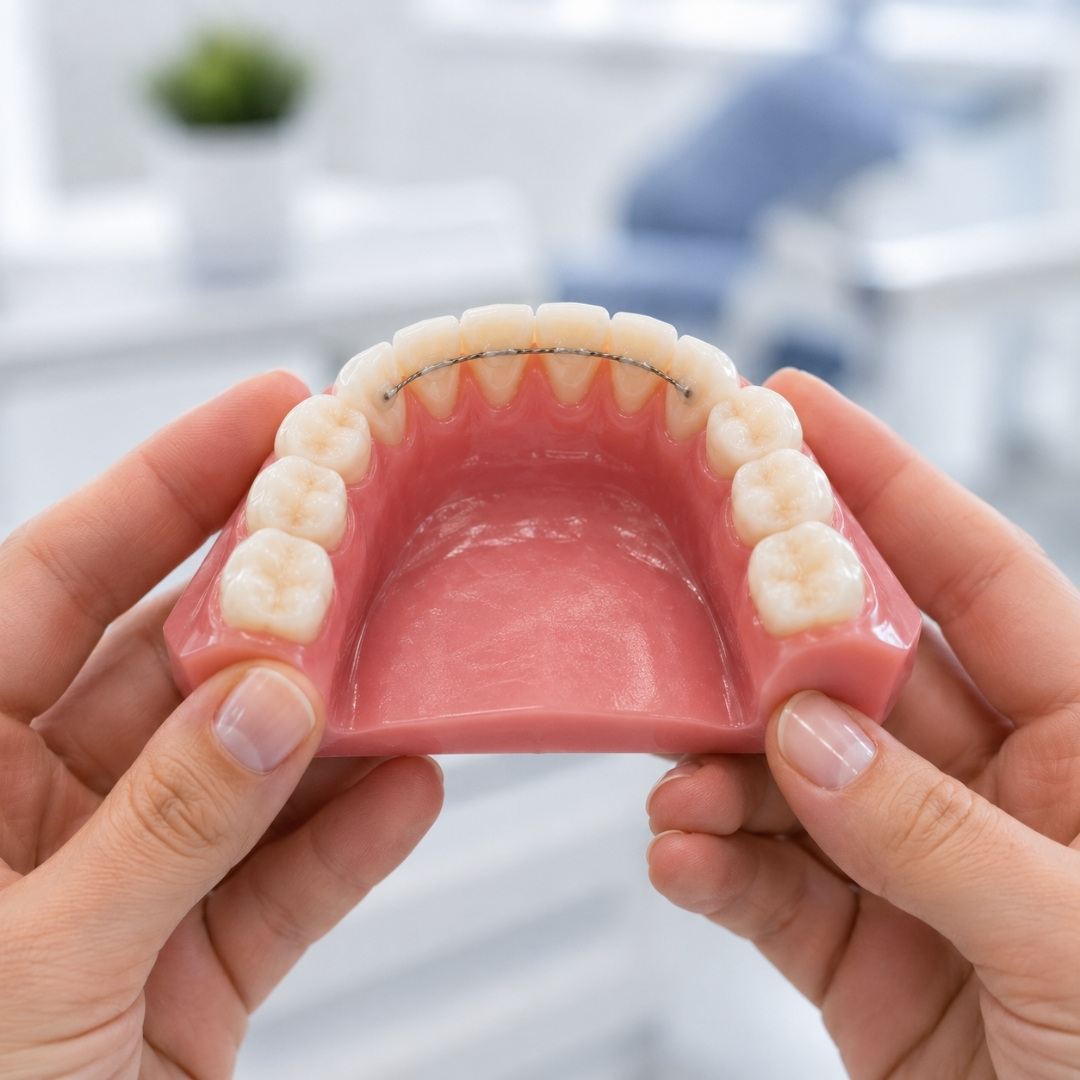
The two main types of retainers: fixed and removable
Fixed (glued) retainer
It is a thin (often twisted) metal wire glued to the back of the front teeth — usually six teeth at the top and six at the bottom, sometimes four.
Benefits:
- Works 24 hours a day
- Totally invisible
- Ideal for areas at high risk of recurrence
- No forgetting, no loss possible
Disadvantages:
- More demanding hygiene (special silk or water flosser essential)
- Risk of punctual detachment
- Possible accumulation of tartar
Removable compression
- Hawley Plaque — Acrylic Palace with Metal Arch. Robust and adjustable.
- Clear Compression (Essix / Vivera) — Aligner-like, more discreet. To be replaced every 2 to 5 years.
Benefits:
- Easier hygiene
- Allows you to eat without constraint
Disadvantages:
- Depends on the patient’s discipline
- Risk of Loss
- Replacement cost to be expected
Combined approach
The majority of orthodontists use a combined approach : a fixed retainer on the six lower anterior teeth, and a transparent removable retainer on the upper arch, to be worn at night.
How long should the restraint be worn?
The honest answer: all life, with decreasing frequency.
| Period | Recommended port |
|---|---|
| Months 1 to 6 | 22 hours a day |
| Months 7 to 12 | 12 hours a day |
| Year 2 | All night, every night |
| Year 3+ | All night, 3 to 5 times a week |
| For life | 2 to 3 nights per week, minimum |
The fixed restraint remains stuck 24 hours a day.
What to do if your restraint breaks, gets lost or no longer closes
- If it breaks — Do not attempt to repair it with glue. Call the clinic within 24 to 48 hours.
- If it gets lost — Call the clinic. A remanufacture is possible within the week.
- If it no longer closes — This is a sign that the teeth have started to move. Call immediately.
- If the fixed restraint comes loose — Call the clinic within a week.
- If you forget it for several weeks — Take it up immediately. If it closes again, perfect. Otherwise, an evaluation and a short repositioning treatment are possible.
Follow-up of compression at your orthodontist
The typical follow-up protocol: 3 months, 6 months, 1 year, 2 years, then annual or biennial.
At Archambault & Morton, follow-up is included in the package for the first two years.
Recidivism without restraint: what really happens
At 15 years after the end of treatment, without restraint, the majority of patients have a partial recurrence. More than a third of them end up wanting to re-treat — an investment that could have been avoided by simple restraint.
The price of compression
The cost depends on the type of restraint chosen (fixed, Hawley, Essix/Vivera) and the need for replacement. The exact rates will be given to you during the consultation.
At Archambault & Morton, restraint is included in the treatment package, as well as the first two years of follow-up.
Hygiene and maintenance
Fixed Restraint:
- Soft-bristled toothbrush
- Special dental floss (Superfloss type) or water flosser
- Scaling at the dentist every 6 months
Removable retainer:
- Rinse with cold water (never hot — acrylic warps)
- Gentle brushing, without toothpaste
- Cleansing tablet 1-2 times a week
- Store in a hard case when not in use
FAQ-EN
Can fixed restraint stay for life? Yes — and it’s often recommended.
Does compression hurt? No. Slight discomfort is possible for the first few hours, but nothing more.
Can you speak normally with a removable restraint? A slight alteration of the “s” and “ch” sounds is possible for 3 to 7 days, the time of adaptation.
My orthodontist told me that I didn’t need restraint. Is this credible? Very doubtful. Ask for a second opinion.
Is there a problem with MRIs or dental X-rays? None.
How long before replacing a removable retainer?
- Essix / Vivera: 2 to 5 years
- Hawley: 5 to 10 years
What about orthognathic surgery? A reinforced protocol is applied: fixed compression on both arches for 3 years, then removable compression at night, for life.

Are you looking for an orthodontist in Vaudreuil-Dorion?
We welcome you with a smile!
Archambault Morton Orthodontic Clinic offers different types of orthodontic treatments to patients of all ages. The orthodontist couple, Amy Archambault and Paul Morton, as parents, attach great importance to the welcome and orthodontic care reserved for the youngest.
The clinic’s team makes every effort to provide toddlers, children, teenagers and adults with an ideal environment and to make their visit pleasant and easy.

Ready to book your first consultation?
FINANCIAL OPTIONS AND INSURANCE
Several payment and coverage options are available to you depending on your treatment. Our team helps you see things clearly.
A FIRST CONSULTATION TO PREPARE!
Before any treatment, the first consultation allows a clear diagnosis to be made and the next steps to be planned. This is the starting point.
QUESTIONS?
Our team is at your disposal to answer all your questions, before, during and after your treatment.
Book a Free Consultation
Fill out the form below to book a free consultation with our clinic.